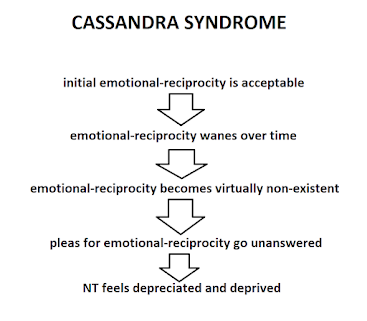
5 life events that commonly make a woman realize she may have Cassandra Syndrome:

Women experiencing what’s often called Cassandra syndrome in a neurodiverse relationship usually don’t recognize it all at once. It often becomes visible through repeated life moments that leave them feeling emotionally invisible, chronically alone, or psychologically exhausted despite being married or deeply committed.
Here are five life events that commonly make a woman realize something deeper is happening:
-
A major emotional crisis happens — and she feels alone inside it
This might be the death of a parent, postpartum depression, a medical diagnosis, burnout, or a child struggling emotionally. What shocks her isn’t only the crisis itself — it’s the emotional absence of her partner during it. He may solve practical problems, stay logical, or withdraw entirely, while she desperately needs emotional attunement. That gap can feel devastating.
-
She stops bringing up her feelings because it never changes anything
At first, she explains carefully. Then repeatedly. Then emotionally. Eventually she notices she is rehearsing conversations in her head before speaking because she expects confusion, defensiveness, shutdown, literalism, or emotional disengagement. Over time, she becomes quieter — not because the pain disappeared, but because hope for emotional reciprocity faded.
-
Friends or therapists don’t fully understand what she’s describing
She says things like:
- “He’s a good man, but I still feel lonely.”
- “It’s like we speak different emotional languages.”
- “I feel emotionally abandoned, but I can’t explain why.”
Outsiders may see a responsible husband, stable home, or lack of overt abuse, which makes her doubt herself. That invalidation often intensifies the isolation.
-
She realizes she has become the emotional manager of the entire relationship
She tracks birthdays, emotional tone, conflict repair, family dynamics, social planning, difficult conversations, the children’s emotional needs, and often her partner’s stress level too. She begins noticing that if she stops initiating emotional connection, the relationship can feel emotionally flat for days or weeks.
-
Her body starts showing the stress before her mind fully admits it
Many women describe chronic anxiety, hypervigilance, insomnia, emotional numbness, brain fog, resentment, exhaustion, or feeling “emotionally starved.” Some develop autoimmune flare-ups, panic symptoms, or depression. The nervous system begins reacting to long-term emotional deprivation and unpredictability even when the relationship looks “functional” from the outside.
A key nuance: not every difficult marriage is a neurodiverse marriage, and not every autistic partner creates these dynamics. But when chronic emotional misattunement combines with invalidation and loneliness over many years, many women begin using the term Cassandra syndrome because it finally gives language to an experience they couldn’t previously explain.
 |
| Mark Hutten, M.A. |
Pick Your Preferred Day/Time
Available Classes with Mark Hutten, M.A.:
==> Cassandra Syndrome Recovery for NT Wives <==
==> Online Workshop for Men with ASD level 1 <==
==> Online Workshop for NT Wives <==
==> Online Workshop for Couples Affected by Autism Spectrum Disorder <==
==> ASD Men's MasterClass: Social-Skills Emotional-Literacy Development <==
Individual Zoom Call:
==> Life-Coaching for Individuals with ASD <==
Downloadable Programs:
==> eBook and Audio Instruction for Neurodiverse Couples <==