The Day I Stopped Waiting for One Person to Meet Every Need
There was no dramatic argument
that changed my life. There wasn't a moment when I packed a suitcase, stormed
out the door, or finally reached the end of my patience. The change happened
much more quietly than that. It arrived on an ordinary evening after what
looked like an ordinary conversation. My husband and I had talked about our
day, discussed a few practical matters, and exchanged the kind of words that,
from the outside, probably appeared completely normal. Yet when the
conversation ended, I found myself sitting alone in the living room with an
ache I could no longer ignore. It wasn't anger that I felt. It wasn't even
disappointment anymore. It was a deep, familiar loneliness that had slowly
settled into the background of my life until it felt almost ordinary.
As I sat there, I began to
realize something that had never occurred to me before. Without intending to, I
had built my entire emotional world around one person. Every hope for comfort,
understanding, encouragement, empathy, companionship, and connection had become
centered on my husband. Whenever those needs weren't met, I had nowhere else to
take them. I had quietly allowed the rest of my world to shrink until my
marriage had become the only place where I expected to find emotional
nourishment. Looking back now, I can see how gradually it happened. There was
never a conscious decision to isolate myself. Life simply became consumed with
trying to make the relationship work. Every ounce of emotional energy was
invested in understanding autism, improving communication, avoiding conflict,
and hoping that if I just explained myself one more time, somehow everything
would finally click.
During those years I slowly
stopped calling friends because I was exhausted from trying to explain what
life at home actually felt like. Most people simply didn't understand. From the
outside, my husband appeared intelligent, responsible, hardworking, and caring.
They saw a good man, and in many ways he truly was. What they couldn't see was
the emotional loneliness that existed behind closed doors. They couldn't see
the conversations that left me feeling unseen or the countless moments when I
longed for empathy but instead received problem-solving, logic, or silence.
Trying to explain those experiences often left me feeling even more alone, so
eventually I stopped trying altogether.
As time passed, I also stopped
accepting invitations. Friends would ask me to join them for lunch or coffee,
and I would politely decline because I felt emotionally drained. Family members
invited us to gatherings, but I often chose to stay home because pretending
everything was fine required more energy than I had. Even when people reached
out with genuine kindness, I found myself withdrawing. I convinced myself that
I simply didn't have time, but if I am honest, I think I had begun believing
that no one could possibly understand what I was living through. Isolation
slowly became my normal, even though it was quietly starving my heart.
One afternoon, after another week
of feeling emotionally depleted, I met an old friend for coffee. I almost
canceled that morning because I didn't think I had anything left to give.
Instead, I forced myself to go. We sat together for nearly two hours, and
something unexpected happened. She didn't offer solutions. She didn't tell me
to try harder or suggest another communication strategy. She didn't defend my
husband, nor did she criticize him. She simply listened. As I talked, she
looked at me with compassion instead of confusion. When I finished speaking,
she quietly said, "That sounds incredibly lonely." Those four words
reached something inside me that I hadn't realized had been hurting for years.
I didn't need someone to solve my marriage that afternoon. I simply needed
another human being to acknowledge my experience.
Driving home, I realized how long
it had been since I had felt emotionally understood. It wasn't because my
husband didn't care. It was because emotional understanding and emotional
expression can be profoundly difficult for many autistic individuals. That
realization helped me develop compassion for him, but it also helped me
recognize something equally important. Compassion for my husband did not
require neglecting myself. I had spent years believing those two things were
somehow connected. I assumed that taking care of my own emotional needs meant
expecting less from my marriage or somehow betraying my commitment. In reality,
the opposite was true. Caring for myself gave me the emotional strength to
remain compassionate without becoming emotionally depleted.
That simple coffee meeting became
the beginning of something much larger than I ever expected. I began reaching
back out to people I had unintentionally pushed away. I joined a women's Bible
study where conversations extended beyond polite greetings into genuine
friendship. I started taking walks with another woman from church every week,
and those quiet walks often became places where laughter returned to my life. I
found a counselor who understood neurodiverse marriages and, for the first
time, I no longer felt as though I had to convince someone that my loneliness
was real. Eventually I discovered a support community filled with women whose
stories sounded remarkably similar to my own. Listening to them describe
experiences that mirrored mine helped dissolve years of self-doubt. I realized
that I wasn't overly sensitive, emotionally needy, or expecting something
unreasonable. I was simply a human being who needed connection.
One of the greatest surprises was
discovering that building relationships outside my marriage did not weaken my
marriage. In many ways, it strengthened it. Before, every interaction with my
husband carried enormous emotional weight because I unconsciously expected him
to fill every empty place inside me. If he missed an emotional cue or struggled
to respond with empathy, it felt devastating because there was nowhere else for
me to receive what I needed. Once I developed meaningful friendships and
healthy sources of support, that pressure gradually disappeared. I no longer
walked into every conversation hoping it would rescue me from loneliness.
Instead, I approached our relationship with greater peace because my emotional
life had become richer and more balanced.
I began to understand that no
healthy marriage is designed to provide every form of human connection.
Throughout history, people have lived within families, neighborhoods,
friendships, faith communities, and extended relationships. We were created to
belong to communities, not emotional islands. Somewhere along the way, I had
accepted the modern idea that my spouse should meet nearly every emotional need
I had. When that expectation wasn't fulfilled, I assumed something was deeply
wrong with me, with him, or with our marriage. What I eventually learned was
that expecting one person to become our entire emotional ecosystem places an
impossible burden on any relationship.
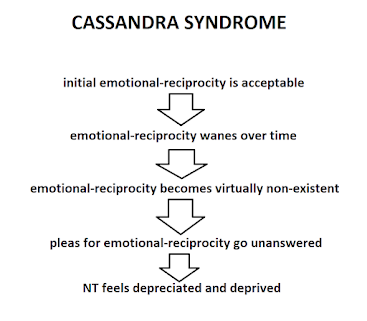
Many women living with Cassandra
Syndrome quietly carry guilt about seeking connection elsewhere. They worry
that joining a support group somehow dishonors their husband or that spending
time with friends reflects a lack of commitment to their marriage. I understand
those fears because I carried them myself. What finally changed my perspective
was realizing that healthy connection is not a substitute for marriage. It is
nourishment for the person living within the marriage. Receiving encouragement
from trusted friends, wisdom from mentors, support from counselors, and
companionship from a caring community does not compete with love for a spouse.
Instead, those relationships help restore the emotional resources that chronic
loneliness gradually depletes.
Today my marriage still has
challenges. Autism has not disappeared, and neither have the differences that
sometimes make emotional connection difficult. Yet my life feels profoundly
different because my identity no longer depends entirely on what happens inside
my marriage. My world has become larger than my loneliness. There are people
who celebrate with me, pray for me, encourage me, and remind me who I am when
discouragement begins whispering otherwise. Their presence has not solved every
problem, but it has changed the way I carry them.
If you have slowly watched your
own world become smaller over the years, I hope you will consider taking one
gentle step toward connection. You do not need to rebuild your entire life
overnight. Sometimes healing begins with something as simple as accepting an
invitation for coffee, attending a small group, calling a trusted friend, or
allowing yourself to be known by someone who is safe. Those small moments have
a remarkable way of growing into something much larger. They remind us that
while marriage is an important part of life, it was never meant to become the
whole of it.
For a long time, I believed that
if my husband could not fully understand my heart, then loneliness would simply
be my permanent companion. I no longer believe that. I have learned that while
one relationship may have limits, life itself does not. There are compassionate
people waiting to listen, communities waiting to welcome you, and friendships
capable of bringing light back into places that have grown dim. Reaching toward
those relationships is not a sign that you have failed. It is an act of hope.
It is an act of wisdom. Most of all, it is a reminder that you were never
created to carry the weight of your life alone.
 |
| Mark Hutten, M.A. |
Pick Your Preferred Day/Time
Available Classes with Mark Hutten, M.A.:
==> Cassandra Syndrome Recovery for NT Wives <==
==> Online Workshop for Men with ASD level 1 <==
==> Online Workshop for NT Wives <==
==> Online Workshop for Couples Affected by Autism Spectrum Disorder <==
==> ASD Men's MasterClass: Social-Skills Emotional-Literacy Development <==
Individual Zoom Call:
==> Life-Coaching for Individuals with ASD <==
Downloadable Programs:
==> eBook and Audio Instruction for Neurodiverse Couples <==