They Thought the Darkness Would Last Forever

Real Women Who Found Hope Beyond Cassandra Syndrome
When you're living with the loneliness, confusion, and
emotional exhaustion often associated with what many people call Cassandra
syndrome, it can feel as though no one has ever survived what you're
experiencing. Days blur together. Anxiety becomes your constant companion.
Depression quietly steals your energy, your confidence, and eventually your
sense of identity. Many women describe feeling invisible inside their own
marriage—deeply committed to someone they love while simultaneously grieving
the emotional connection they desperately need.
Yet hope is not merely wishful thinking. Around the world,
many women have publicly shared stories of rebuilding their lives after years
of emotional isolation in neurodiverse marriages. Their journeys are not
identical, nor did all of them remain in their marriages. But they demonstrate
something profoundly encouraging: healing is possible.
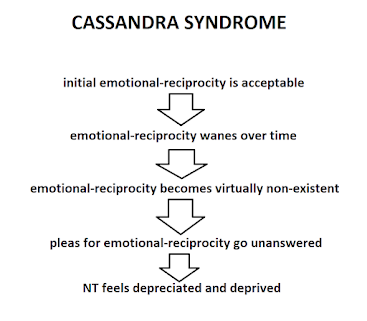
It is important to note that "Cassandra syndrome"
is widely used within support communities but is not an officially
recognized mental health diagnosis. Instead, it describes a pattern of
emotional distress that some partners report experiencing in chronically
disconnected relationships, particularly in some neurodiverse marriages.
Natalie has openly documented her journey through the
emotional collapse and eventual recovery that followed years of
misunderstanding within her neurodiverse marriage. She has written candidly
about feeling as though her personality slowly disappeared. She described
losing her confidence, her spontaneity, and even the sparkle in her eyes.
Rather than continuing to search for one breakthrough
conversation that would finally change everything, Natalie gradually shifted
her focus inward. Therapy, education about autism, boundaries, self-care, and
rebuilding her own identity became the center of her healing process.
Her recovery did not happen overnight. It unfolded through
hundreds of small decisions to reconnect with herself instead of measuring her
worth by her spouse's emotional responsiveness.
One lesson stands out throughout her story: healing began
when she stopped waiting for permission to care for herself.
Today she writes, teaches, and encourages others walking
similar paths, demonstrating that emotional recovery is possible even after
years of loneliness.
Libby has publicly shared that she spent more than three
decades feeling deeply confused and emotionally depleted before her husband's
autism was recognized. She describes years of sadness, discouragement, and
questioning her own perceptions.
What changed was not a perfect marriage.
What changed was her relationship with herself.
She began learning healthier emotional boundaries, building
supportive relationships outside her marriage, strengthening her spiritual
life, and accepting that she could influence only her own responses—not another
person's neurological wiring.
Libby's message today is remarkably hopeful. She acknowledges
that neurodiverse marriage remains challenging, but she no longer defines
herself by chronic disappointment. Instead, she speaks about living with
renewed peace, purpose, and emotional stability.
The woman identified publicly as Becky through the Healing
Cassandra community shared that she nearly left her marriage because of years
of emotional exhaustion.
Her breakthrough came when she realized something many
therapists try to teach but that is incredibly difficult to believe when you're
depressed:
"I can't change him, only me."
Instead of spending every ounce of emotional energy trying to
create empathy in her spouse, she invested that energy into caring for herself.
She built friendships, sought education, found community, and developed
healthier emotional boundaries.
According to her testimony, those changes transformed not
only her own well-being but also the emotional atmosphere of her marriage.
Another woman, Jacqueline, publicly describes one of the
greatest turning points in her recovery as finding a community where she no
longer had to explain or defend her experiences.
For many women experiencing chronic emotional loneliness, one
of the deepest wounds is not simply feeling disconnected from a spouse. It is
feeling disbelieved by friends, family, counselors, or even themselves.
Jacqueline describes discovering a safe community where her
experiences were understood without judgment. The reduction in isolation became
a powerful antidote to anxiety.
Her story reminds us that healing often begins long before a
marriage changes. Sometimes it begins the moment another person says, "I
believe you."
Although every story is different, several common themes
emerge.
None of these women waited until their marriages became
perfect before beginning their own recovery.
Each sought support instead of continuing to suffer alone.
Each learned that boundaries reduce anxiety more effectively
than endless arguments.
Each rebuilt an identity outside the role of spouse.
Each stopped measuring daily success by whether their partner
finally understood them emotionally.
Most importantly, every one of them discovered that healing
is an inside-out process.
If you are struggling with depression or anxiety while
navigating a neurodiverse marriage, these stories do not promise easy answers.
They do not suggest that every marriage will dramatically improve or that every
relationship can or should be saved.
They offer something quieter—and perhaps more valuable.
They show that you can rediscover yourself.
You can laugh again.
You can sleep peacefully again.
You can rebuild friendships.
You can learn to trust your own perceptions.
You can regain confidence that has been worn down by years of
misunderstanding.
Whether your future includes rebuilding your marriage or
making difficult decisions about its direction, your emotional healing does not
have to wait. As these women demonstrate, recovery begins the moment you
recognize that your well-being matters too.
 |
| Mark Hutten, M.A. |
Pick Your Preferred Day/Time
Available Classes with Mark Hutten, M.A.:
==> Cassandra Syndrome Recovery for NT Wives <==
==> Online Workshop for Men with ASD level 1 <==
==> Online Workshop for NT Wives <==
==> Online Workshop for Couples Affected by Autism Spectrum Disorder <==
==> ASD Men's MasterClass: Social-Skills Emotional-Literacy Development <==
Individual Zoom Call:
==> Life-Coaching for Individuals with ASD <==
Downloadable Programs:
==> eBook and Audio Instruction for Neurodiverse Couples <==