When Autism Finally Has a Name: How a Late Diagnosis Changes Everything for Neurotypical Wives Living with Cassandra Syndrome

For many neurotypical wives, a late diagnosis of autism in their husband does not simply answer a lingering question—it fundamentally changes the way they understand their entire marriage. What once appeared to be emotional neglect, stubbornness, indifference, or an unwillingness to connect is suddenly viewed through an entirely different lens. Decades of painful experiences begin to organize themselves into a coherent story. Behaviors that once felt deeply personal begin to make neurological sense. This realization is often both profoundly validating and deeply heartbreaking. While a diagnosis cannot change the past, it can transform how the past is understood, allowing both partners to revisit years of conflict with greater compassion and far less confusion.
Many neurotypical wives describe feeling as though they have lived in two completely different marriages. The first is the marriage everyone else sees. Friends, family members, coworkers, and even therapists may observe a dependable, hardworking husband who faithfully provides for his family and appears kind, responsible, and emotionally stable. From the outside, the marriage may look healthy and secure. The second marriage is the one experienced behind closed doors, where emotional conversations seem to go nowhere, attempts at intimacy are repeatedly met with silence or problem-solving instead of empathy, and moments that long for connection somehow leave one partner feeling more alone than before. This invisible emotional reality often becomes increasingly difficult to explain because there are few outward signs that anything is wrong.
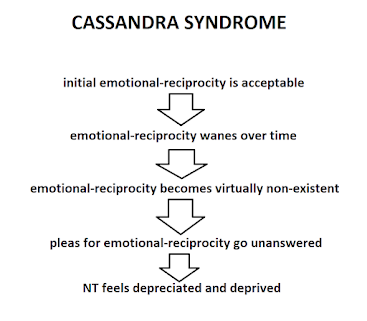
One of the cruelest aspects of this experience is that many wives eventually stop trusting their own perceptions. When they seek support, they frequently hear comments such as, "At least he isn't abusive," "He's just quiet," or "Maybe your expectations are too high." While these statements are usually intended to be reassuring, they often deepen the wife's isolation. Instead of validating her experience, they subtly suggest that her loneliness is either exaggerated or self-created. Over time, many women begin questioning themselves instead of questioning the explanation they have been given. They wonder whether they really are too emotional, too demanding, or simply impossible to satisfy. This gradual erosion of self-trust becomes one of the defining characteristics of what has become known as Cassandra Syndrome—the experience of chronic emotional deprivation within a relationship where the emotional reality remains largely invisible to others.
For many couples, the discovery of autism comes unexpectedly and often much later in life than anyone would have imagined. Sometimes the journey begins after one of the children receives an autism diagnosis and similarities begin emerging within the family. Sometimes years of unsuccessful marriage counseling eventually lead a knowledgeable clinician to recognize autistic characteristics that had gone unnoticed for decades. In other cases, the husband begins researching his lifelong struggles with relationships, work, sensory sensitivities, or social communication and gradually recognizes himself in the descriptions of Level 1 autism. Regardless of how the diagnosis arrives, it often produces an extraordinary moment of clarity. Suddenly the rigid routines, sensory sensitivities, emotional shutdowns, social exhaustion, literal communication style, and intense need for predictability all become pieces of a much larger neurological picture. Instead of seeing hundreds of isolated frustrations, couples begin recognizing one underlying pattern that has quietly influenced nearly every aspect of their relationship.
This new understanding often brings an enormous sense of relief. Finally, there is an explanation that makes sense. The wife realizes that many of the behaviors she interpreted as rejection may have originated from neurological differences rather than intentional disregard. The husband begins understanding why so many aspects of life have always felt unusually difficult despite his sincere efforts. Yet alongside this relief comes another powerful emotion: grief. Couples frequently find themselves mourning years that cannot be recovered. Wives wonder how different their marriages might have been if someone had recognized autism twenty or thirty years earlier. They question how many nights they spent crying, blaming themselves, or desperately trying to fix problems that neither partner truly understood. Husbands often experience their own grief as they recognize how frequently their wives felt lonely while they genuinely believed they were doing the best they could with the neurological resources available to them. The diagnosis does not simply answer questions about the present; it forces both partners to reinterpret an entire shared history.
One of the most significant insights offered by a late diagnosis is the realization that emotional distance is not necessarily the same as emotional indifference. Many autistic husbands love their wives deeply and remain profoundly committed to their families. However, loving someone and consistently communicating that love are two very different abilities. Autism frequently affects the recognition of subtle emotional cues, the interpretation of indirect communication, the timing of emotional responses, and the ability to rapidly shift attention during emotionally intense conversations. The desire for connection may be entirely genuine even when the expression of that desire appears limited or inconsistent. Understanding this distinction does not erase the wife's loneliness, but it changes the explanation for why that loneliness developed. What once appeared to be a lack of caring may actually reflect a neurological difference in emotional processing and communication.
An important concept that helps explain much of this relational tension is sensory gating. Although unfamiliar to many people, sensory gating refers to the brain's ability to filter incoming sensory information so that attention can remain focused on what matters most. Every second, the brain receives enormous amounts of information from the environment, including sounds, lights, textures, movement, conversations, bodily sensations, visual details, and countless other forms of stimulation. Most neurotypical brains automatically screen out much of this information before it reaches conscious awareness. This filtering process allows attention to remain available for social interaction, emotional connection, and complex thinking. Research suggests that many autistic brains process sensory information differently, allowing far more incoming stimulation to compete for attention simultaneously. Rather than functioning like an efficient filter, the nervous system may remain flooded with competing sensory information throughout the day.
This difference becomes particularly important within marriage because emotional connection requires mental and neurological resources. Imagine trying to have an intimate conversation while dozens of radios are playing at the same time. Even if you desperately want to listen, your brain eventually reaches its processing capacity. For many autistic husbands, an ordinary workday involves managing fluorescent lights, background conversations, social expectations, constant decision-making, traffic, changing schedules, uncomfortable clothing, and countless other sensory demands that gradually exhaust the nervous system. By the time they arrive home, they may have very little emotional bandwidth remaining. Their wives often experience this exhaustion as withdrawal or disinterest, while the husbands themselves experience it as neurological depletion. Both experiences are genuine. Both deserve validation. Unfortunately, without understanding sensory gating, each partner naturally interprets the other's behavior through assumptions that often intensify rather than reduce conflict.
Another common misconception involves the nature of emotional experience itself. Autism does not necessarily reduce emotional depth. In fact, many autistic adults report experiencing emotions with extraordinary intensity. The challenge often lies not in feeling emotions but in organizing, processing, and expressing them quickly enough during live interpersonal interactions. As emotional intensity increases, cognitive processing may begin slowing down. Words become more difficult to retrieve. Thoughts become disorganized. Problem-solving may replace emotional validation because the brain shifts toward managing overload rather than deepening connection. Silence, withdrawal, or seemingly flat facial expressions may emerge not because emotions are absent, but because the nervous system is overwhelmed. From the perspective of the neurotypical wife, these moments often feel painfully rejecting. From the perspective of the autistic husband, they frequently represent a brain struggling to keep pace with overwhelming internal and external demands.
Understanding these neurological processes should never invalidate the emotional pain experienced by neurotypical wives. Years of loneliness remain deeply painful. Missed opportunities for intimacy cannot simply be erased by receiving a diagnosis. Forgotten anniversaries, emotionally disconnected conversations, and countless moments of feeling unseen continue to matter because they shaped the emotional landscape of the marriage. Validation requires acknowledging that these experiences were real. At the same time, understanding autism allows couples to recognize that many of these painful moments were not created by a lack of love but by differences in neurological functioning that neither partner understood. Both truths can exist simultaneously. The wife experienced genuine emotional deprivation, and the husband experienced genuine neurological limitations. Compassion grows when couples stop forcing themselves to choose between these realities and begin accepting both.
For many wives, one of the greatest gifts of a late diagnosis is the restoration of trust in their own experience. They discover that they were not imagining the loneliness they felt for so many years. They were not too sensitive, too demanding, or emotionally unstable. Their nervous system had been responding to a very real pattern of inconsistent emotional reciprocity. Having a neurological explanation does not diminish the legitimacy of that pain. Instead, it allows them to stop blaming themselves for circumstances they could never fully understand without the missing neurological framework. This restoration of self-trust often becomes one of the first and most important steps toward healing.
Likewise, many autistic husbands begin experiencing compassion for themselves in ways they never previously believed possible. For decades they may have accepted labels such as cold, stubborn, selfish, rigid, or emotionally unavailable without realizing that many of these descriptions reflected neurological differences rather than character flaws. Understanding autism allows them to replace years of shame with greater self-awareness and to recognize that although they remain responsible for learning healthier relationship skills, they were never intentionally choosing many of the behaviors that caused so much confusion.
As couples begin rebuilding their relationship, the focus gradually shifts from blame to curiosity. Instead of asking why one partner behaved a certain way, they begin asking what each person's nervous system was experiencing in that moment. This subtle shift changes the emotional tone of nearly every conversation. Curiosity naturally lowers defensiveness because it assumes there is something meaningful to understand rather than someone to blame. Conversations become opportunities for discovery instead of evidence gathering. Partners begin learning not only how the other thinks but how the other experiences the world itself.
Perhaps the greatest gift of a late diagnosis is the opportunity to redefine what a healthy marriage actually looks like. Rather than measuring themselves against neurotypical expectations, couples begin creating a relationship that reflects the realities of two different nervous systems. Communication becomes more direct, recovery from sensory overload becomes intentional, emotional needs become more explicit, and both partners learn to build connection in ways that fit their unique neurological profiles. Instead of asking why their marriage does not resemble everyone else's, they begin asking what allows their own relationship to flourish.
A late autism diagnosis cannot restore the years that were lost to misunderstanding, nor can it erase the loneliness that many neurotypical wives experienced along the way. What it can do is replace confusion with understanding, replace shame with compassion, and replace blame with curiosity. Perhaps most importantly, it validates a truth that countless wives have needed to hear for years: your pain was real. You were not imagining it, exaggerating it, or asking for too much. At the same time, it offers autistic husbands an equally important truth: many of your lifelong struggles were rooted in neurological differences rather than personal failure. Healing begins when both partners are finally able to see the same story—not as adversaries trying to determine who was right, but as two people who spent decades navigating profoundly different neurological realities without a map. For many couples, that shared understanding becomes the true beginning of a new chapter, one built not on blame for the past, but on hope for the future.
 |
| Mark Hutten, M.A. |
Pick Your Preferred Day/Time
Available Classes with Mark Hutten, M.A.:
==> Cassandra Syndrome Recovery for NT Wives <==
==> Online Workshop for Men with ASD level 1 <==
==> Online Workshop for NT Wives <==
==> Online Workshop for Couples Affected by Autism Spectrum Disorder <==
==> ASD Men's MasterClass: Social-Skills Emotional-Literacy Development <==
Individual Zoom Call:
==> Life-Coaching for Individuals with ASD <==
Downloadable Programs:
==> eBook and Audio Instruction for Neurodiverse Couples <==