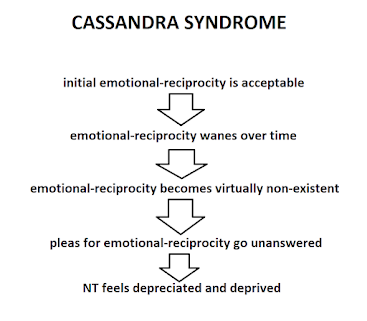
When Childhood Emotional Neglect Looks Like Autism: A Hidden Source of Confusion for Cassandra Syndrome
One of the most painful questions asked by spouses in high-conflict relationships is also one of the most difficult to answer:
"Is my partner autistic... or were they emotionally neglected as a child?"
For many people living with Cassandra Syndrome, this question is not academic. It is deeply personal. Years of emotional loneliness, repeated misunderstandings, failed conversations, and unmet emotional needs often leave partners searching desperately for an explanation that finally makes sense.
The challenge is that childhood emotional neglect and autism can sometimes look remarkably similar from the outside. Both can produce emotional distance. Both can make a person appear disconnected from their own feelings. Both can interfere with empathy, communication, emotional reciprocity, and conflict resolution. Both can leave a spouse feeling painfully unseen.
This overlap creates what might be called diagnostic fog—a confusing place where two very different developmental pathways produce behaviors that appear almost identical.
Unfortunately, many couples become trapped in that fog.
One spouse becomes convinced that autism explains everything. The other insists the problem is unresolved childhood trauma. Friends and family offer opinions. Internet checklists create even more confusion. Therapists may disagree. Meanwhile, the relationship continues to deteriorate because everyone is arguing about labels instead of understanding the underlying mechanisms driving the behavior.
The distinction matters, not because one explanation is "better" than the other, but because healing depends on accurately understanding what created the behavior in the first place.
Imagine standing outside two homes and seeing smoke rising from both roofs. One house is burning. The other has a fireplace lit on a cold evening. The smoke looks identical, but the causes could not be more different. If firefighters respond to the fireplace as though it were a blaze, they create unnecessary chaos. If they assume the burning house simply has a cozy fire inside, disaster follows.
Relationships work much the same way. Emotional shutdown, poor communication, difficulty identifying feelings, withdrawal during conflict, and apparent indifference are the smoke. The question is not whether the smoke exists. The question is what is producing it.
For many adults who experienced childhood emotional neglect, the emotional world was never intentionally explored. Their parents may have provided food, clothing, education, and physical safety. They may have sincerely loved their child. Yet something essential was missing. Feelings were ignored, minimized, dismissed, or simply never discussed. Nobody consistently asked, "What are you feeling?" Nobody patiently helped organize overwhelming emotions. Nobody reflected back, "That must have hurt," or "I can understand why you're upset."
Children naturally conclude that what receives attention must matter. Conversely, what receives no attention gradually disappears from conscious awareness. A child whose emotional experiences are repeatedly overlooked often adapts by paying less attention to them altogether. This is not a conscious decision. It is an elegant survival strategy developed by an immature nervous system trying to function in an emotionally barren environment.
Years later, that same child grows into an adult whose spouse asks a simple question: "How are you feeling?"
The answer often comes back almost automatically.
"I don't know."
To the spouse, that answer can feel dismissive, evasive, or uncaring. In reality, the individual may genuinely have difficulty identifying what is happening inside. They never learned the emotional language that many people absorb naturally during childhood.
Psychologists often refer to this difficulty as alexithymia—an impaired ability to identify, understand, and describe one's own emotional experience.
Here is where the confusion deepens.
Alexithymia is also commonly found among autistic individuals.
Suddenly, two completely different developmental histories produce nearly identical conversations inside a marriage.
The emotionally neglected partner says, "I don't know what I'm feeling."
The autistic partner says, "I don't know what I'm feeling."
The spouse hears the same words.
The internal reasons, however, may be entirely different.
In autism, emotional awareness may be influenced by neurological differences affecting interoception, emotional processing, and social cognition from early childhood. In emotional neglect, emotional awareness may have been gradually suppressed because emotions were consistently ignored or unsafe to express.
The outward presentation looks remarkably similar.
The developmental origins are not.
Empathy creates another layer of confusion.
Many spouses suffering from Cassandra Syndrome eventually conclude that their partner has no empathy at all. After years of feeling emotionally abandoned, that conclusion often feels obvious.
Yet the reality is frequently more nuanced.
Empathy is not a single ability. It consists of multiple processes working together. One must notice emotional cues, recognize their meaning, regulate one's own emotional response, and then respond in a way that communicates understanding.
Childhood emotional neglect disrupts several of these steps. When individuals become disconnected from their own emotional experiences, they naturally become less skilled at recognizing those same experiences in others. The nervous system learns to avoid emotional territory because emotional territory was never safe, predictable, or meaningful.
This often creates an appearance of emotional blindness.
The person may genuinely care.
They simply cannot find the emotional map.
Autism creates similar challenges through a different pathway. Social information may be processed differently from the beginning of life. Facial expressions, vocal tone, implied meanings, indirect communication, and rapidly changing emotional contexts may require significantly more cognitive effort to interpret. The autistic individual often feels overwhelmed not because emotions are dangerous, but because social information itself is extraordinarily complex and neurologically demanding.
Again, identical behavior can emerge from completely different developmental processes.
Perhaps nowhere is this confusion more visible than during marital conflict.
Consider two spouses who both become silent whenever disagreements arise.
From the outside, they appear identical.
One learned in childhood that emotional expression led to criticism, dismissal, or emotional abandonment. Silence became the safest survival strategy available.
The other experiences escalating sensory overload, cognitive flooding, and diminished processing capacity as conflict intensifies. Silence becomes the only remaining way to reduce overwhelming neurological input.
One nervous system is avoiding remembered emotional pain.
The other is reducing present neurological overload.
The silence looks exactly the same.
The meaning could not be more different.
This distinction becomes especially important for spouses experiencing Cassandra Syndrome because many have spent years trying interventions that never seemed to work. They have tried explaining their feelings more clearly. They have attended communication workshops. They have read relationship books. They have practiced active listening. They have pleaded, reasoned, negotiated, and sometimes even withdrawn themselves.
When nothing changes, hopelessness grows.
If the underlying issue is trauma-related emotional suppression, treatments that increase emotional awareness, attachment security, and nervous system regulation may produce meaningful change over time.
If the underlying issue is autism, progress often comes through psychoeducation, structured communication, sensory accommodations, explicit relationship skills, and developing mutual understanding of neurological differences.
Neither pathway is easy.
Neither guarantees a perfect marriage.
But each requires a different therapeutic map.
Adding even more complexity, these conditions frequently coexist.
Many autistic children experience emotional neglect—not because their parents lacked love, but because their emotional needs were more difficult to recognize, understand, or consistently meet. A child can grow up neurologically autistic while simultaneously developing trauma adaptations related to chronic misunderstanding, bullying, rejection, or emotional isolation.
In those cases, autism and emotional neglect intertwine so thoroughly that separating them becomes extraordinarily difficult.
The goal, therefore, is not necessarily to determine which label is "correct."
The deeper goal is understanding which processes are operating today.
- What happens inside this person's nervous system during conflict?
- What overwhelms them?
- What calms them?
- What increases emotional access?
- What shuts it down?
Those questions are often far more clinically useful than debating diagnostic categories.
For spouses living with Cassandra Syndrome, this understanding can become surprisingly liberating.
Many partners have spent years believing that every painful interaction reflected indifference or a lack of love. Sometimes that interpretation is incomplete. Sometimes the behaviors are rooted in developmental wounds that neither partner fully understands.
At the same time, understanding is not the same thing as excusing harmful behavior.
Whether emotional distance arises from autism, childhood emotional neglect, or both, the impact on the relationship remains real. Chronic loneliness still hurts. Emotional abandonment still wounds. Invalidating experiences still accumulate. Compassion for the origin of a behavior should never require denying its effect.
Healthy relationships require both truth and empathy.
The greatest gift accurate understanding provides is not simply a diagnosis. It is a clearer path forward.
When couples understand the mechanisms beneath the behavior, they stop fighting symptoms and begin addressing the actual problem. They replace blame with curiosity. They exchange assumptions for careful observation. They learn that two people can experience the same conflict while living inside completely different nervous systems.
For many couples, that shift marks the beginning of genuine healing. Not because everything suddenly becomes easy. But because, for the first time, they are solving the right problem.
 |
| Mark Hutten, M.A. |
Pick Your Preferred Day/Time
Available Classes with Mark Hutten, M.A.:
==> Cassandra Syndrome Recovery for NT Wives <==
==> Online Workshop for Men with ASD level 1 <==
==> Online Workshop for NT Wives <==
==> Online Workshop for Couples Affected by Autism Spectrum Disorder <==
==> ASD Men's MasterClass: Social-Skills Emotional-Literacy Development <==
Individual Zoom Call:
==> Life-Coaching for Individuals with ASD <==
Downloadable Programs:
==> eBook and Audio Instruction for Neurodiverse Couples <==