When Fear Replaces Connection in Neurodiverse Marriages

One dynamic I see repeatedly in my work involves a neurodiverse couple—specifically, a man on the autism spectrum (ASD) and a neurotypical (NT) wife—who have been stuck in unresolved conflict for years.
At this stage, something surprising is often true:
The autistic husband is genuinely afraid of his wife.
That statement may sound extreme, but it’s not an exaggeration. Over time, fear replaces connection, and both partners feel trapped in a cycle neither intended to create.
How This Pattern Develops
This dynamic usually begins innocently enough.
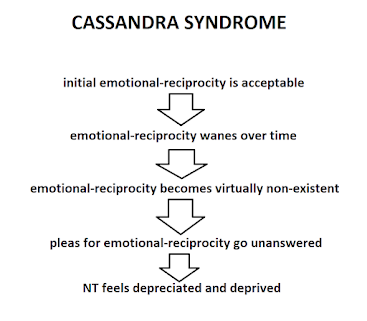
The NT wife experiences a lack of emotional reciprocity. Her expectations for connection, validation, empathy, and shared emotional life are not being met. She feels lonely, unseen, and increasingly distressed.
With good intentions, she tries to fix the relationship. She initiates conversations, points out problems, suggests changes, and pushes for closeness. She is trying to save the marriage.
But inside the autistic husband’s mind, these repeated efforts often download as:
-
Complaining
-
Criticism
-
Being corrected
-
Being parented
-
Never being “good enough”
Over time, he begins to feel like he’s constantly in trouble—like he’s on thin ice every day. Many men tell me they feel as if they are perpetually “in the doghouse,” no matter what they do.
Eventually, he reaches a painful conclusion:
“It doesn’t matter what I say or do—it’s never good enough.”
Fear Leads to Withdrawal
Once that belief sets in, fear takes over.
To reduce anxiety, the autistic husband begins to shut down. He speaks less. He engages less. He spends more time alone or immersed in work or special interests. He avoids conversations that feel risky.
From the NT wife’s perspective, this withdrawal feels devastating. She interprets it as:
-
“He doesn’t care.”
-
“I’m not important.”
-
“The relationship means nothing to him.”
But in many cases, the truth is different.
He’s not disengaging because he doesn’t care—he’s disengaging to avoid conflict.
He believes he cannot win, cannot fix things, and cannot meet expectations. Silence feels safer than trying and failing again.
Fight, Flight, and Shutdown
This dynamic often oscillates between extremes.
Most of the time, the autistic husband is in flight—shutdown, avoidance, emotional distance. Occasionally, the pressure builds until he flips into fight, which can look like an adult meltdown or explosive reaction.
Then he retreats again.
This back-and-forth leaves both partners exhausted and hopeless.
What’s Really Underneath the Arguments
Arguments are rarely about the surface issue.
Underneath anger is fear.
Both partners are afraid—just of different things.
-
The NT wife may fear:
-
Her emotional needs will never be met
-
Loss of connection
-
Being invisible or unimportant
-
-
The autistic husband may fear:
-
Criticism
-
Being shamed or corrected
-
Being disrespected
-
Being emotionally overwhelmed
-
We don’t argue without reason. Arguments consume enormous emotional energy because something deeply important feels threatened.
And here’s the problem:
Arguing does not address fear.
It intensifies it.
Unresolved arguments increase anger, which increases fear, which guarantees the next argument will be even more intense.
A Reflective Exercise: Finding the Fear
I often assign this exercise to both partners, individually—not as a couple.
-
Think back to a recent argument.
-
Ask yourself:
-
Why was I so invested in defending myself?
-
What was I afraid of in that moment?
-
-
Identify the fear underneath the anger.
Write it down.
Then ask a second question:
What could actually address this fear?
Arguing hasn’t worked. So what might?
Shifting From Arguments to Conversations
For example:
-
If an NT wife identifies her fear as “My emotional needs will never be met,” the next step is not another argument—but a calm conversation about how those needs might realistically be met.
-
If an autistic husband identifies his fear as “I’m constantly criticized,” then he needs to help his wife understand how she can express herself without triggering that perception.
The goal is not perfection.
The goal is conversation instead of combat.
Why Problem-Solving Often Fails
Another issue I see nearly 100% of the time is this:
The couple cannot agree on what the problem actually is.
She says, “The problem is emotional disconnection.”
He says, “No, the problem is how you talk to me.”
And they go in circles.
Before you can solve a problem, you must first identify it—and sometimes that means accepting there are two versions of the same problem (Problem A and Problem B).
That’s still progress.
Trying to solve two different problems at the same time guarantees failure.
Why “Damage Control” Backfires
NT wives often enter what I call damage control mode when the relationship has been declining for months or years.
They see the marriage sinking and desperately try to rally their partner:
“We’re in trouble. Can we work together? Can you help me fix this?”
This makes sense. When humans are distressed, they cry out for help. When help doesn’t come, they escalate—complaints turn into anger, anger into resentment.
But with an autistic partner who struggles with emotional reciprocity, those cries for help often increase anxiety rather than evoke compassion.
The result is tragic:
The more she reaches out, the more he retreats.
The Core Dilemma
NT partners often wonder:
“Should I just meet my own emotional needs?”
But that’s as unrealistic as a five-year-old parenting themselves after getting hurt.
You cannot be in a marriage alone.
So something must change.
The Path Forward
What has to change is the approach.
To pull an autistic partner in rather than push them away, communication must keep their anxiety low while still honoring the NT partner’s emotional needs.
This is not intuitive.
It is not a quick fix.
And it usually requires professional guidance.
Finding a therapist or counselor experienced in autism and neurodiverse relationships is often essential. The goal is to develop a communication strategy that allows both partners to feel safe, heard, and respected.
That’s where healing begins—not with louder arguments, but with fear finally being understood.
==> Cassandra Syndrome Recovery for NT Wives <==
 |
| Mark Hutten, M.A. |
Pick Your Preferred Day/Time
Available Classes with Mark Hutten, M.A.:
==> Cassandra Syndrome Recovery for NT Wives <==
==> Online Workshop for Men with ASD level 1 <==
==> Online Workshop for NT Wives <==
==> Online Workshop for Couples Affected by Autism Spectrum Disorder <==
==> ASD Men's MasterClass: Social-Skills Emotional-Literacy Development <==
Individual Zoom Call:
==> Life-Coaching for Individuals with ASD <==
Downloadable Programs:
==> eBook and Audio Instruction for Neurodiverse Couples <==