When Self-Sufficiency Looks Like Rejection: Understanding the Autistic Husband and the Pain of Cassandra Syndrome
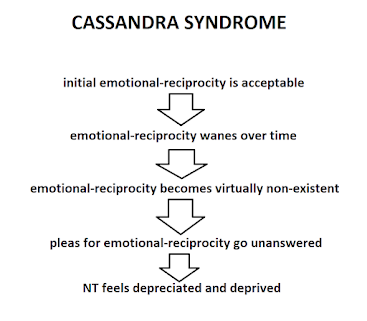
In many neurodiverse marriages, one of the most confusing and painful dynamics revolves around something that, on the surface, appears simple: the autistic husband’s need for solitude and self-sufficiency. What often feels to him like emotional regulation, decompression, or simply returning to equilibrium can look to his neurotypical (NT) wife like something very different—distance, indifference, or even rejection. When this pattern repeats over months or years, many NT wives begin to experience what has come to be known as Cassandra syndrome: the deep distress that arises when one partner feels emotionally unseen, unheard, and alone within the marriage.
The difficulty is not that either partner is malicious or uncaring. In fact, in most neurodiverse marriages both partners are trying very hard. The struggle emerges because the behaviors that help the autistic husband function well in the world are often interpreted by his wife through an entirely different emotional lens.
To understand why this happens, we have to look closely at the internal experience of both partners.
The Autistic Nervous System and the Need for Solitude
For many autistic adults, solitude is not avoidance—it is regulation.
Daily life can involve a constant stream of sensory information, social expectations, emotional signals, and decision-making demands. Conversations require interpretation of tone, facial expressions, and implied meanings. Environments may contain noise, lighting, movement, and unpredictability that the nervous system must continuously process.
Over time, this creates a form of cognitive and sensory fatigue.
Alone time becomes the way the nervous system resets.
For an autistic husband, stepping away into a quiet room, immersing himself in a hobby, working on a project, or simply sitting in silence may feel similar to plugging a depleted battery into a charger. During this time he is not usually thinking, “I want to avoid my wife.” Instead, his mind may be attempting to stabilize after too much input.
Self-sufficiency plays a similar role. Many autistic men learn early in life that relying heavily on others can create confusion or misunderstandings. They may feel safer managing problems internally rather than asking for emotional support that they are unsure how to receive.
To them, independence can represent competence and stability.
Unfortunately, this same independence can communicate something very different to their spouse.
The NT Wife’s Experience of Emotional Disconnection
For many neurotypical wives, emotional closeness is maintained through frequent signals of connection—conversation, shared experiences, eye contact, physical affection, and spontaneous expressions of care.
These behaviors are not simply “nice extras.” They function as emotional reassurance.
When these signals are present, the nervous system interprets the relationship as secure. When they are absent, the brain begins to ask questions.
“Does he care about me?”
“Why doesn’t he want to spend time together?”
“Why am I always the one initiating connection?”
In neurodiverse marriages, the autistic husband may be showing love in ways that feel obvious to him—working hard, solving problems, maintaining routines, providing stability. Yet the NT wife may experience very little of the emotional signaling that tells her she is valued and cherished.
Over time, this mismatch becomes deeply painful.
The wife may begin to feel invisible. Her attempts to talk about the emotional distance may be met with confusion, logical explanations, or silence. When she expresses hurt, the husband may genuinely not understand why his normal behavior is causing distress.
This is where Cassandra syndrome begins to emerge.
Why Self-Sufficiency Can Feel Like Rejection
In many marriages, partners depend on each other emotionally. They share stress, seek comfort, and rely on each other as a primary source of support.
When an autistic husband handles most challenges internally, the NT wife can feel shut out of his world.
She may interpret his independence as a message:
“I don’t need you.”
Even if that message is never spoken, the emotional experience can be powerful. Humans are wired for belonging, and relationships are one of the primary places where that need is fulfilled.
When a wife repeatedly tries to connect but encounters withdrawal, quietness, or solitary activity, her brain may begin to perceive abandonment—even though her husband is physically present in the home.
This dynamic can produce a painful cycle.
The more alone she feels, the more she seeks reassurance.
The more pressure he senses to provide emotional responses that do not come naturally, the more overwhelmed he may become.
And the more overwhelmed he becomes, the more he withdraws.
Both partners end up feeling misunderstood.
The Loneliness of Cassandra Syndrome
Cassandra syndrome often develops when the NT partner’s emotional experience is repeatedly dismissed or minimized—not necessarily intentionally, but through misunderstanding.
A wife may attempt to explain how lonely she feels, only to hear responses such as:
“I’m here, aren’t I?”
“I didn’t do anything wrong.”
“You’re overreacting.”
From the husband’s perspective, these responses may feel logical. He may truly believe he has not done anything harmful. If he is faithful, responsible, and present in daily life, he may struggle to understand why the relationship feels so painful to his spouse.
But from the wife’s perspective, these responses can feel like emotional invalidation.
She is describing distress, and the distress seems to disappear into a void.
Over time, this can create a sense of psychological invisibility. Friends and family may not understand the situation because the husband may appear responsible and stable in public. Therapists unfamiliar with neurodiverse dynamics may unintentionally side with the more emotionally articulate partner.
The wife may begin to feel that her reality is constantly being questioned.
This is the core emotional injury of Cassandra syndrome.
The Autistic Blind Spot
One of the most important pieces of this puzzle is that many autistic husbands genuinely have a blind spot when it comes to emotional signaling.
They may feel love deeply but assume that love is already understood.
To them, the relationship may feel stable simply because they remain committed. They may not realize that the absence of small emotional signals—checking in, expressing appreciation, noticing distress—gradually erodes their partner’s sense of security.
Imagine a house that is structurally sound but receives no warmth or light inside.
From the outside, everything appears stable.
Inside, however, the environment feels cold.
For many NT wives, emotional responsiveness functions like warmth in the home. Without it, the relationship can feel barren even when practical responsibilities are fulfilled.
Recognizing this blind spot does not mean assigning blame. It simply acknowledges that the two partners may be operating with very different relational operating systems.
Bridging the Gap
Understanding the dynamic between autistic self-regulation and NT emotional needs is the first step toward healing.
Neither partner’s needs are wrong.
The autistic husband genuinely requires solitude and independence to maintain equilibrium. Attempting to eliminate that need would likely lead to burnout or shutdown.
At the same time, the NT wife requires emotional responsiveness and connection to feel loved and secure. Ignoring this need leaves her in a state of chronic relational hunger.
The path forward usually involves learning how to translate between these needs rather than eliminating either one.
For the autistic husband, this may mean becoming intentionally aware of emotional signaling. Simple behaviors—brief check-ins, verbal expressions of appreciation, planned connection time—can carry enormous meaning for an NT partner.
For the NT wife, understanding the neurological role of solitude can reduce the tendency to interpret alone time as rejection. When alone time is framed as regulation rather than avoidance, it becomes easier to view it as a neutral or even healthy behavior.
The goal is not to make either partner become someone they are not.
The goal is to create a bridge between two very different relational languages.
Moving from Misinterpretation to Compassion
Many neurodiverse marriages spend years trapped in cycles of misunderstanding. One partner believes they are constantly asking for something basic and reasonable, while the other feels perpetually criticized for simply being themselves.
Yet when both partners begin to understand the neurological and emotional realities behind these behaviors, a surprising shift often occurs.
The NT wife may begin to see that her husband’s solitude is not necessarily a sign of indifference. It may be the mechanism that allows him to function in the relationship at all.
The autistic husband may begin to realize that emotional reassurance is not unnecessary drama—it is a fundamental ingredient of relational safety for his spouse.
When this awareness develops, compassion can slowly replace resentment.
The NT wife’s loneliness becomes understandable.
The autistic husband’s withdrawal becomes understandable.
And in that space of understanding, new conversations become possible.
Neurodiverse marriages often require more intentional communication than neurotypical relationships. But with awareness, patience, and practical tools, many couples discover that what once looked like emotional distance was often a language difference waiting to be translated.
The journey can be challenging, but it also offers an opportunity: the chance to build a relationship that honors both partners’ nervous systems, needs, and ways of loving.
 |
| Mark Hutten, M.A. |
Pick Your Preferred Day/Time
Available Classes with Mark Hutten, M.A.:
==> Cassandra Syndrome Recovery for NT Wives <==
==> Online Workshop for Men with ASD level 1 <==
==> Online Workshop for NT Wives <==
==> Online Workshop for Couples Affected by Autism Spectrum Disorder <==
==> ASD Men's MasterClass: Social-Skills Emotional-Literacy Development <==
Individual Zoom Call:
==> Life-Coaching for Individuals with ASD <==
Downloadable Programs:
==> eBook and Audio Instruction for Neurodiverse Couples <==