When You Feel Invisible: Encouragement for Partners Experiencing Cassandra Syndrome

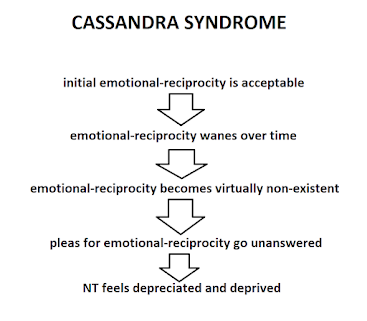
There’s a particular kind of loneliness that doesn’t come from being alone—but from being unseen. If you’re living with what’s often called Cassandra syndrome, you likely know this feeling intimately. You may be in a committed relationship, even a loving one on paper, yet still feel emotionally abandoned, chronically misunderstood, or quietly starved for connection.
And over time, that experience can start to rewrite how you see yourself.
This article is for you.
The Quiet Erosion of Being Unmet
Let’s start with something important: what you’re feeling makes sense.
When your spouse is on the Autism Spectrum Disorder, especially at a level where communication and emotional reciprocity are impacted, there can be a deep mismatch—not of intention, but of expression.
You might find yourself thinking:
- “Why does everything feel one-sided?”
- “Why am I always the one reaching?”
- “Why do I feel more alone in this marriage than I did when I was single?”
These aren’t overreactions. They’re signals.
A Familiar Pattern
Consider this example:
Sarah tries to connect with her husband, Mark, after a long day. She says, “I feel overwhelmed. Can we just talk for a bit?”
Mark, who has ASD, doesn’t respond emotionally. Instead, he says, “You should make a list of what’s overwhelming and prioritize it.”
To him, this is support—he’s offering a solution. But to Sarah, it feels like rejection. She didn’t need a strategy. She needed presence.
Later that night, she withdraws. He notices the distance but doesn’t know how to bridge it. He assumes she wants space. She assumes he doesn’t care.
No one is trying to hurt the other. And yet, both are hurting.
The Core Misalignment
At the heart of this dynamic is a difference in emotional language.
Many individuals with ASD experience challenges with:
- Emotional attunement
- Reading subtle cues
- Expressing empathy in ways that feel natural to neurotypical partners
This isn’t about lack of love. It’s about a different operating system.
But here’s the hard truth:
Understanding the “why” doesn’t automatically meet the “need.”
You can intellectually grasp your partner’s neurology and still feel profoundly alone.
The Double Bind You May Be Living In
You might feel stuck between two painful options:
- Lower your expectations to avoid disappointment
- Keep hoping for change, and feel hurt again and again
That tension creates emotional exhaustion. And over time, many partners begin to question themselves:
- “Am I too needy?”
- “Maybe I’m expecting too much…”
- “Maybe this is just what marriage is like.”
Let’s gently challenge that.
Your needs are not the problem.
But how those needs get met in this relationship does require a different approach.
Reclaiming Your Emotional Ground
Here’s where the shift begins—not by forcing your partner to become someone they’re not, but by helping you become more anchored in your own emotional reality.
1. Name What’s Actually Happening
Instead of saying, “He doesn’t care,” try:
- “I’m not receiving emotional responsiveness in the way I need.”
That distinction matters. It separates your partner’s limitations from your worth.
2. Stop Translating Everything as Rejection
When your partner offers logic instead of empathy, it’s often an attempt to help—not a dismissal.
But—and this is key—that doesn’t mean it meets your need.
Both can be true.
3. Build External Sources of Emotional Support
This is not a failure of your marriage—it’s a realistic adaptation.
Close friendships, therapy, support groups—these aren’t “extras.” They are lifelines.
4. Learn to Make Direct, Concrete Requests
Instead of:
- “I need you to be more supportive”
Try:
- “Can you sit with me for 10 minutes and just listen without offering solutions?”
Specificity helps bridge neurological gaps.
A Different Kind of Hope
Hope in this kind of relationship doesn’t come from waiting for your partner to suddenly become emotionally intuitive.
It comes from:
- Clearer communication
- Realistic expectations
- Intentional support structures
-
And most importantly…
a deeper loyalty to your own emotional experience
You Are Not “Too Much”
If you’ve been carrying this quietly, let this land:
You are not too sensitive.
You are not too needy.
You are not asking for something unreasonable.
You are asking to feel seen, heard, and emotionally held.
Those are deeply human needs.
And One More Thing…
There’s a subtle strength in you that may not get enough recognition.
You’ve likely:
- Tried to understand your partner deeply
- Adjusted your communication
- Held space for differences that many wouldn’t
That speaks to your capacity for empathy and commitment.
But that strength should not come at the cost of your own well-being.
Moving Forward—With Clarity, Not Self-Abandonment
This journey isn’t about choosing between compassion for your partner and care for yourself.
It’s about holding both.
And sometimes that means redefining what connection looks like in your relationship…
and what support needs to exist outside of it.
If this resonates, I’m curious—what part of this dynamic feels the most draining for you right now?
 |
| Mark Hutten, M.A. |
Pick Your Preferred Day/Time
Available Classes with Mark Hutten, M.A.:
==> Cassandra Syndrome Recovery for NT Wives <==
==> Online Workshop for Men with ASD level 1 <==
==> Online Workshop for NT Wives <==
==> Online Workshop for Couples Affected by Autism Spectrum Disorder <==
==> ASD Men's MasterClass: Social-Skills Emotional-Literacy Development <==
Individual Zoom Call:
==> Life-Coaching for Individuals with ASD <==
Downloadable Programs:
==> eBook and Audio Instruction for Neurodiverse Couples <==